External purchase links open in a new tab. Buttons marked Awaiting publisher URL are editable placeholders that will activate once the publisher supplies verified links for this edition.
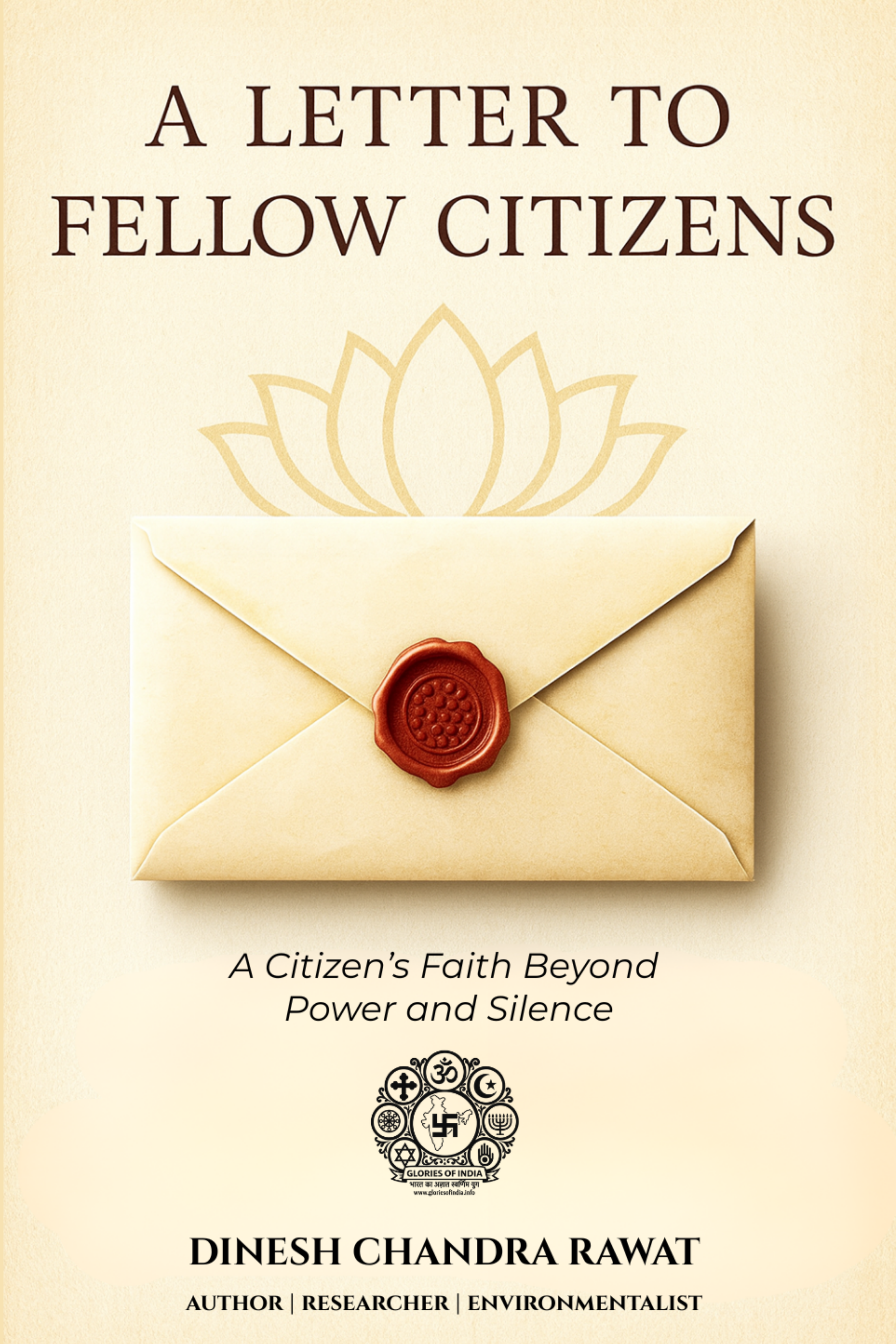
A Letter to Fellow Citizens
A Letter to Fellow Citizens is a personal appeal to Indians to look beyond divisions, rediscover the strength of their civilizational inheritance, and recognise their individual responsibility in building a stronger, more united and confident India.
What responsibility does each citizen carry towards the future of India? A Letter to Fellow Citizens is Dinesh Chandra Rawat's personal appeal to the people of India—an invitation to reflect upon the country's past, understand the challenges of the present and consider what each of us can contribute to its future. Drawing upon decades of travel, observation, reading, historical exploration and engagement with people from different walks of life, the author reflects on India's extraordinary civilizational inheritance as well as the forces and circumstances that have shaped the nation over time. The book addresses questions of national unity, historical awareness, cultural confidence, social responsibility, environmental consciousness and the duties of citizenship. It argues that India's progress cannot depend upon governments and institutions alone. Lasting national transformation also requires informed, responsible and active citizens. At its heart, this is not merely a book about India's problems. It is a call for awareness, participation and constructive action. Written directly to fellow citizens, the book asks readers to rise above unnecessary divisions, examine inherited assumptions, value India's civilizational strengths and consider the country that today's generation will leave for those yet to come. India's future is not someone else's responsibility. It belongs to all of us.
- 01 Chapter – 1- Fellow Citizens — Why I Had to Write This Book
- 02 Chapter – 2- The Letter That Started It All — May 2014
- 03 Chapter – 3- The Farewell That Marked a Beginning (2013–14)
- 04 Chapter – 4- An Era Changer Chosen by Destiny
- 05 Chapter – 5- Two Thousand Years of Wounds — To India’s History
- 06 Chapter – 6- My Oath of Selfless Service to Mother India
- 07 Chapter – 7- A Thousand Pages of Truth
- 08 Chapter – 8- Truth Must Return — India’s History Is the World’s History
- 09 Chapter – 9- A Request for Time — And a Vision Rooted in Nature
- 10 Chapter – 10- The Evidence of a Lifetime — A Civilization Revealed
- 11 Chapter – 11- Sanskrit — The Mother of Languages, the Science of Civilization
- 12 Chapter – 12- Vedic Civilization — The Mother of All Civilizations
- 13 Chapter – 13- Abraham’s Roots in India — A Discovery That Shook Me
- 14 Chapter 14- Jesus in India — A Journey I Walked with My Own Feet
- 15 Chapter – 15- The Aryan Invasion Theory — A Colonial Lie That Crushed a Civilization’s Self-Respect
- 16 Chapter – 16- The Human Story — A Theory Built on Guesswork, Not Truth
- 17 Chapter – 17- The Hidden Truth of India’s Monuments — A Civilization Rewritten Under Foreign Boots
- 18 Chapter – 18- The Taj Mahal — A Palace of Shiva That History Refuses to Remember
- 19 Chapter – 19- Qutub Minar — The Dhruv Stambh of Hindu Civilization, not a Tower of Invasion
- 20 Chapter – 20- Indian Architecture — The World’s Greatest Civilizational Signature Rewritten by Force
- 21 Chapter – 21- The National Anthem — A Colonial Shadow Still Echoing in Free India
- 22 Chapter 22- The Colonial Legal System — The Empire Never Left
- 23 Chapter – 23- The Colonial Education System — A Machine Built to Break India’s Soul
- 24 Chapter – 24- The Need for a New Syllabus — Restoring Truth, Continuity & Cultural Confidence
- 25 Chapter – 25- My Appeal to My Fellow Citizens — A Call to Rise for Mother India
- 26 Chapter – 26- Bharat’s Environmental Dharma — The Prakriti Path
- 27 Chapter – 27- A National Vision for 2047 — Bharat’s Civilizational Renaissance
- ◆ How to critically evaluate historical narratives.
- ◆ Why civilizational awareness matters in modern society.
- ◆ The importance of environmental responsibility alongside national development.
- ◆ How informed citizenship contributes to a stronger democracy.
- ◆ Ways to think independently using evidence and multiple perspectives.
- ◆ Civilizational continuity and cultural preservation
- ◆ Personal responsibility in nation-building
- ◆ India's future vision for 2047
- ◆ Leadership and public values
- ◆ Education and social responsibility
- ◆ Environmental stewardship
- ◆ National identity and citizenship
- ◆ Archaeology and ancient India
- ◆ Historical research and evidence
- ◆ Indian civilization and cultural heritage
"A nation's future is shaped by how honestly it understands its past."
"Truth does not fear questions; it welcomes honest inquiry."
"History should unite citizens through knowledge, not divide them through misunderstanding."
"The greatest inheritance we can leave future generations is an informed and responsible society."
"Every citizen has the power to strengthen Bharat through knowledge, character, and action."
Reviews will appear here once verified by the publisher. No reviews, awards or ratings are shown until confirmed in writing.
For libraries, schools and institutions, please write to us using the contact form.
Enquire for Bulk Orders