External purchase links open in a new tab. Buttons marked Awaiting publisher URL are editable placeholders that will activate once the publisher supplies verified links for this edition.
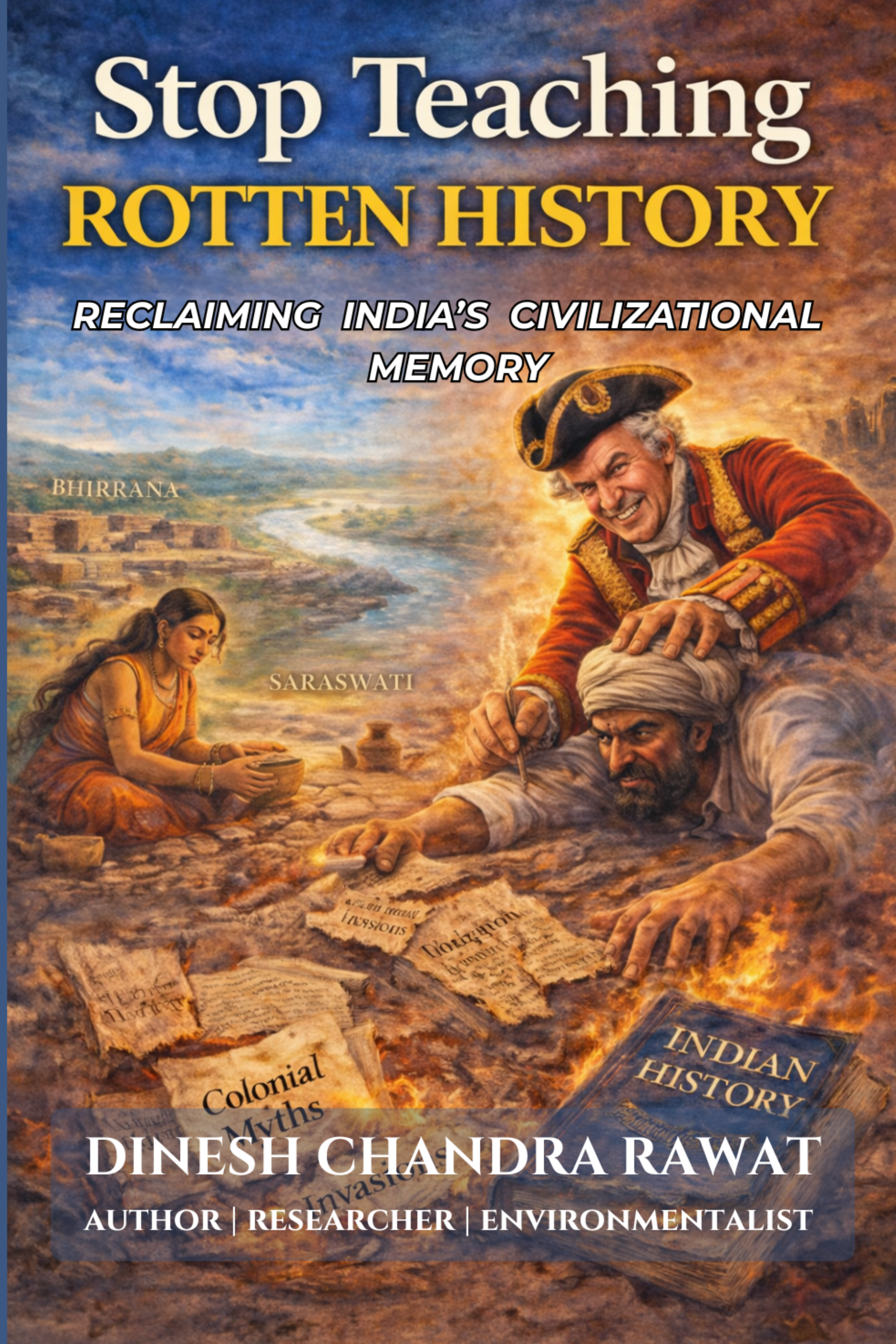
Stop Teaching Rotten History
Stop Teaching Rotten History challenges long-repeated narratives about India's past and invites a new generation to examine history with curiosity, evidence and an independent mind. Written in an accessible style, the book explores questions that every young Indian deserves the opportunity to investigate.
What happens when generations learn history largely through narratives inherited from earlier systems of education and interpretation? Stop Teaching Rotten History — The Truth Every Young Indian Should Know invites readers to look again. Drawing upon decades of independent exploration, reading, visits to historical and archaeological sites, and engagement with India's civilizational heritage, Dinesh Chandra Rawat examines important questions about how India's past has been presented and understood. The book encourages readers—particularly younger Indians—to distinguish between evidence, interpretation and inherited assumptions. It explores India's ancient civilization, knowledge traditions, cultural continuity, historical achievements and the ways in which colonial-era interpretations influenced later understandings of Indian history. Rather than asking readers simply to accept another version of history, the book encourages them to question, investigate, compare evidence and reach informed conclusions. Written in clear and approachable language, Stop Teaching Rotten History is intended not only for students and history enthusiasts, but for parents, teachers and every reader interested in understanding India's civilizational journey. A book for a generation ready to question what it has been taught—and discover what the evidence can tell us.
- 01 Chapter 1 Is History Neutral or Manipulated?
- 02 Chapter 2 - The Cost of Forgetting: How Memory was Broken
- 03 Chapter 3 - How India’s Timeline Was Shrunk
- 04 Chapter 4 - Plunder By the Pen
- 05 Chapter 5 - The Aryan Invasion Theory
- 06 Chapter 6 - Sarasvati: A River in Memory, Erased from Maps
- 07 Chapter 7 - Before Recorded History
- 08 Chapter 8 - Evolution, Assumption, And Civilizational Memory
- 09 Chapter 9 - Before Theories, There Was Observation
- 10 Chapter 10 - From Observation to Abstraction
- 11 Chapter 11 - Knowledge As Continuity, Not Accumulation
- 12 Chapter 12 - Iron, Steel, And Rust-Free Pillars
- 13 Chapter 13 - From Nalanda to Colonial Universities
- 14 Chapter 14 - Reconnecting Knowledge with Civilization
- 15 Chapter 15 - Bhakti, Folk Traditions, And Women’s Voices
- 16 Chapter 16 - Festivals As Historical Memory
- 17 Chapter 17 - Sacred Groves and Water Tanks
- 18 Chapter 18 - Unity In Diversity
- 19 Chapter 19 - How History Education Can Restore Self-Respect
- 20 Chapter 20 - Rewriting History Curricula
- 21 Chapter 21 - Youth As Custodians, Not Just Inheritors
- 22 Chapter 22 - Authors and Educators as Cultural Shapers
- 23 Chapter 23 - History As a Tool for Civilizational Renaissance
- ◆ How to evaluate historical claims using multiple sources of evidence.
- ◆ The importance of archaeology, geography, and indigenous literature in historical research.
- ◆ Key debates surrounding India's ancient civilization and cultural continuity.
- ◆ Why history education shapes national identity and informed citizenship.
- ◆ Colonial Historiography
- ◆ Aryan Debate
- ◆ Saraswati Civilization
- ◆ Archaeology and Ancient India
- ◆ Ancient Universities
- ◆ Indian Knowledge Systems
- ◆ Maritime History
- ◆ Temple Ecosystems
- ◆ Environmental Heritage
- ◆ Educational Reform
History should unite a civilization with truth, not divide it through distortion.
A nation that forgets its civilizational memory risks losing its confidence and direction.
History is not merely about the past—it shapes the future of every generation.
Question inherited narratives. Follow the evidence wherever it leads.
India's story is far older, deeper, and more continuous than many textbooks suggest.
Archaeology, science, geography, and ancient literature together reveal a broader historical picture.
Civilizations grow stronger when they understand their own heritage with honesty and humility.
Education should encourage inquiry, not unquestioning acceptance of established narratives.
The search for historical truth begins with curiosity and respect for evidence.
Understanding the past is essential for building a confident and responsible future.
India's civilizational heritage deserves to be explored through multidisciplinary research.
History is not meant to be memorized alone—it is meant to be understood.
“"Stop Teaching Rotten History is a thoughtful invitation to re-examine India's past through evidence, archaeology, and independent research. Dinesh Rawat encourages readers to question inherited narratives and engage with history critically and respectfully. A valuable contribution to discussions on India's civilizational heritage."”
For libraries, schools and institutions, please write to us using the contact form.
Enquire for Bulk Orders