External purchase links open in a new tab. Buttons marked Awaiting publisher URL are editable placeholders that will activate once the publisher supplies verified links for this edition.
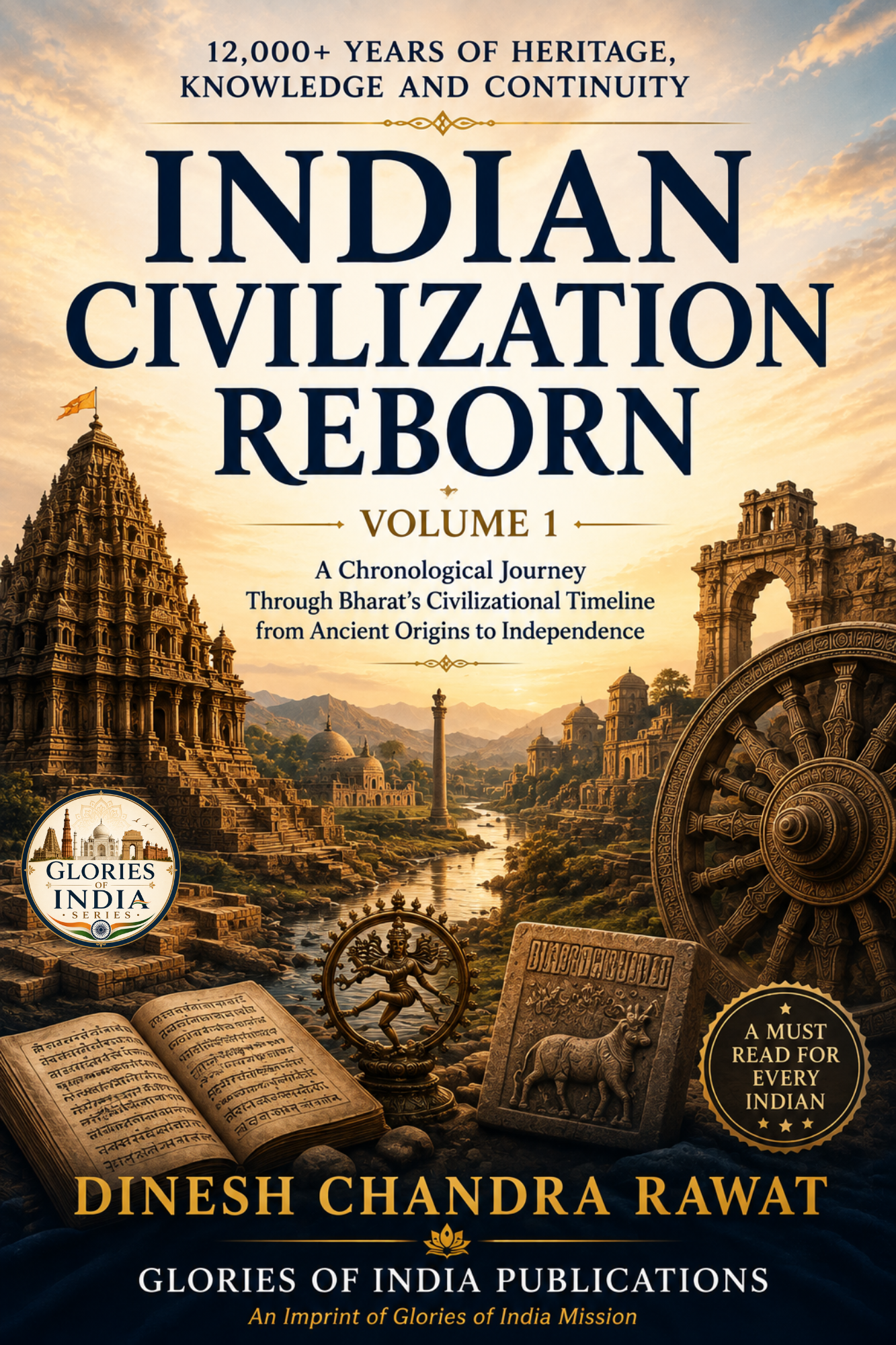
Indian Civilization Reborn
Indian Civilization Reborn is a multidisciplinary exploration of Bharat’s ancient civilizational journey. Bringing together archaeology, ancient literature, scientific research, geography, genetics, astronomy, cultural continuity and field investigation, Dinesh Chandra Rawat re-examines major questions about the antiquity, achievements and enduring legacy of Indian civilization.
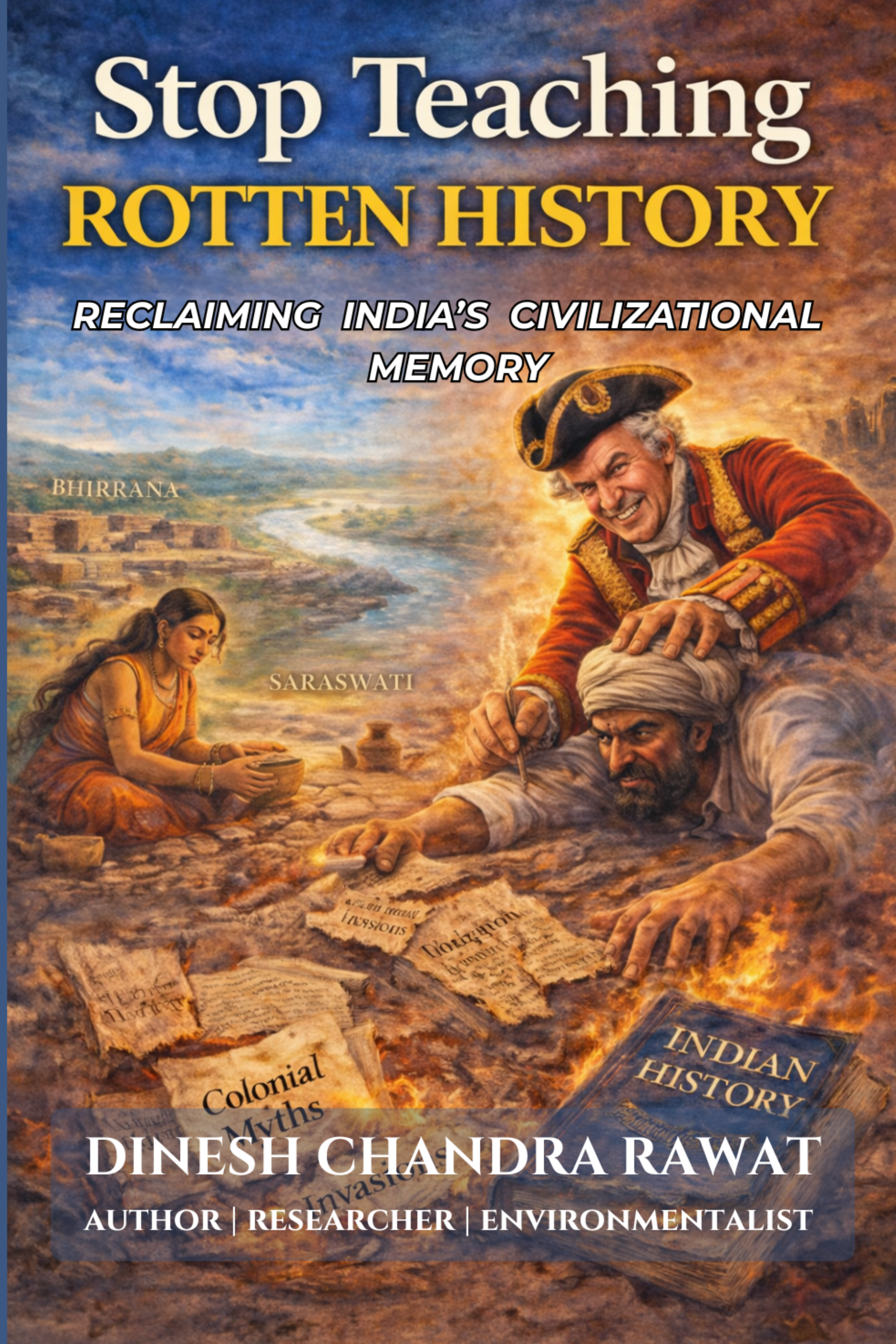
How ancient is Indian civilization—and how much of its extraordinary story remains to be rediscovered? Indian Civilization Reborn is the culmination of Dinesh Chandra Rawat’s decades-long exploration of India’s civilizational past. Rather than examining history through a single discipline, the work brings together evidence and perspectives from archaeology, ancient Indian literature, geography, geology, genetics, astronomy, scientific research, historical records, cultural traditions and extensive field exploration. The book investigates some of the most important questions surrounding Bharat’s past: the antiquity and continuity of Indian civilization; the Saraswati and the settlements associated with its landscape; archaeological discoveries across the subcontinent; the historical and cultural traditions surrounding the Ramayana and Mahabharata; India’s ancient knowledge systems; and the continuity of ideas, places and practices across generations. It also examines how India’s history came to be interpreted during the colonial period and how later archaeological and scientific discoveries have contributed new evidence to long-standing debates. A central principle of the book is that evidence from different disciplines should be examined together. Archaeological discoveries can be compared with geography; ancient literature with landscapes and cultural memory; traditional chronologies with modern scientific investigation. Some conclusions and chronological interpretations advanced by the author differ from currently prevailing academic interpretations. They are presented as the outcome of his research and field investigation, with readers encouraged to distinguish between established evidence, scholarly debate and the author’s own conclusions. Richly supported by maps, timelines, photographs, archaeological material and explanatory visuals, Indian Civilization Reborn is designed to make a vast civilizational story accessible to both serious readers and a new generation seeking to understand Bharat beyond conventional textbook narratives. A civilization is not reborn by inventing its past. It is reborn by rediscovering, examining and understanding it.
- 01 Chapter 1 - What Is a Civilization?
- 02 Chapter 2 - Why Bharat?
- 03 Chapter 3 - Sacred Geography
- 04 Chapter 4 -Knowledge, Memory And Cultural Continuity
- 05 Chapter 5 - The Saraswati
- 06 Chapter 6 - Before the Cities
- 07 Chapter 7 - Rakhigarhi
- 08 Chapter 8 - Dwarka
- 09 Chapter 9 - The Ramayana: History, Memory, and Civilization
- 10 Chapter 10 - Rama Setu
- 11 Chapter 11 - The Mahabharata
- 12 Chapter 12 - Sanskrit
- 13 Chapter 13 - Ancient Universities
- 14 Chapter 14 - Ancient Science & Innovation
- 15 Chapter 15- Temple Science
- 16 Chapter 16 - Maritime Bharat
- 17 Chapter 17 - A Great Civilization, A Distorted Narrative
- 18 Chapter 18- The Oral Tradition
- 19 Chapter 19 - The Future Of Civilization
- 20 Chapter 20- Indian Civilization Reborn
- ◆ Civilizational Continuity Understand the evidence and arguments surrounding the antiquity and continuity of Indian civilization.
- ◆ The Saraswati Question Explore archaeological, geographical, textual and scientific perspectives concerning the Saraswati and its associated settlements.
- ◆ Archaeology and Ancient India Discover how archaeological sites and material evidence are reshaping discussions about India's ancient past.
- ◆ Epics, Geography and Cultural Memory Examine how the Ramayana and Mahabharata traditions can be studied alongside geography, archaeology and continuing cultural traditions.
- ◆ Ancient Knowledge Systems Explore important dimensions of India's intellectual, scientific and cultural heritage.
- ◆ Colonial Historiography Understand how colonial-era frameworks influenced interpretations of Indian history and why some of those interpretations continue to be debated.
- ◆ This field is much more appropriate for books such as Terrace Gardening for Indian Homes, Landscaping Expertise for India and Palms for Indian Gardens.
A civilization is not reborn by inventing its past. It is reborn by rediscovering, examining and understanding it.
Evidence from archaeology, science, ancient texts and living traditions must be examined together before we understand the full story of Bharat.
The history of Bharat is not merely a record of what survived in books; it also lives in its landscapes, traditions and civilizational memory.
Reviews will appear here once verified by the publisher. No reviews, awards or ratings are shown until confirmed in writing.
For libraries, schools and institutions, please write to us using the contact form.
Enquire for Bulk Orders